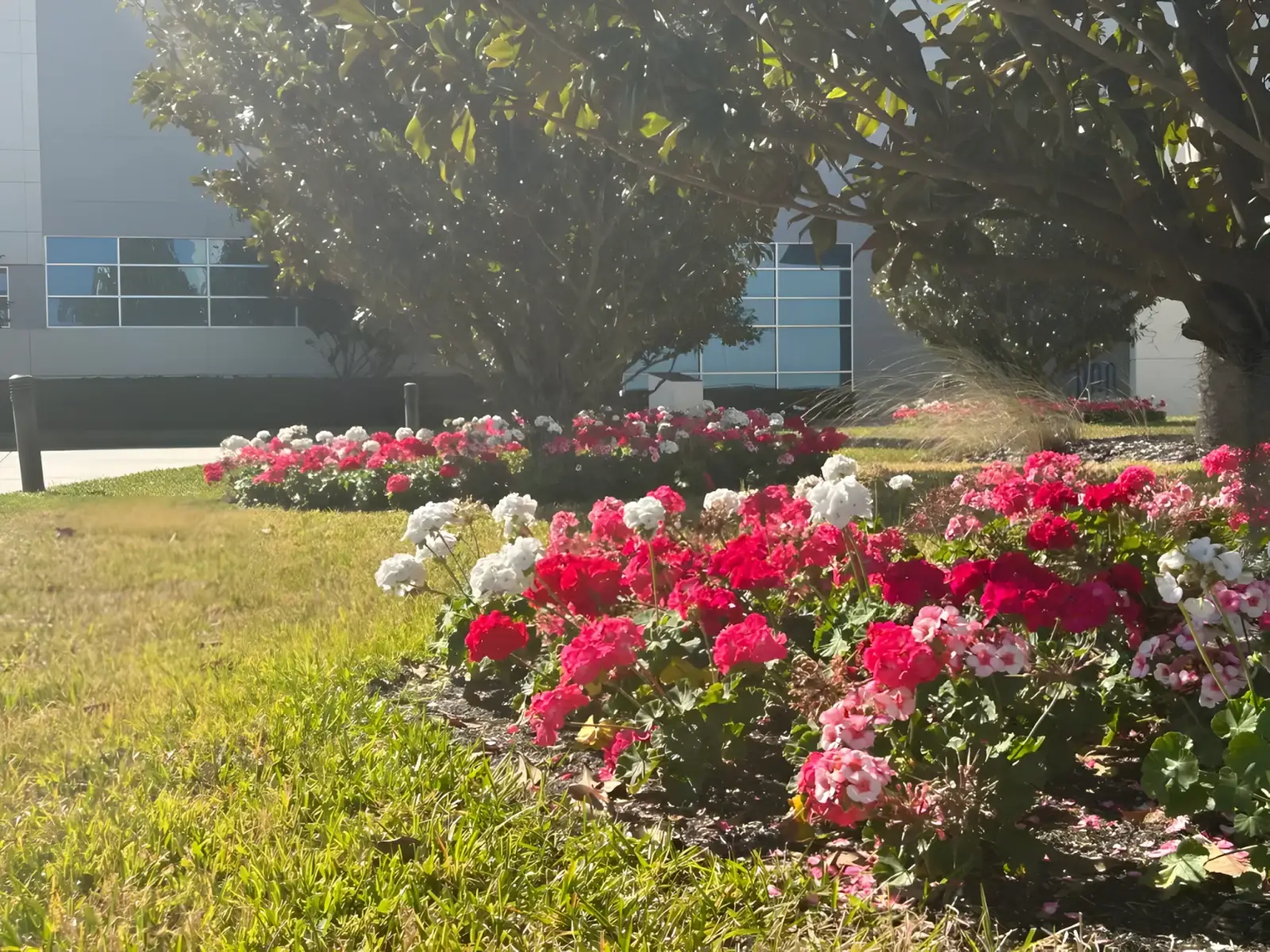
Seasonal color is the smallest line in a commercial landscape budget and the one people notice first. A bed of fresh annuals at an entrance signals that the property is being looked after. A bed of tired, leggy plants signals the opposite, and it signals it to every tenant, visitor and prospective buyer who drives in.
Where to put it and how often to change it are the decisions that matter.
Put the color where people stop
Most commercial properties have a small number of places where visitors actually pause: the main entrance, the monument sign, the lobby doors and the visitor parking row. That is where color earns its cost.
Spreading the same budget thinly across every bed on the property produces beds that all look slightly under-planted. Concentrating it on three or four locations produces beds that look deliberate.
Stand where a first-time visitor stops their car. What they can see from that spot is worth planting. What they cannot is worth mulching well.
Tampa has two planting seasons, not four
Northern rotation calendars do not transfer to Florida. Here the year splits roughly in two, and the dividing line is heat.
Cool season, roughly November to April. This is the good period. Petunias, snapdragons, dianthus, pansies and violas all perform, and the color lasts because nights are cool.
Warm season, roughly May to October. Heat, humidity and daily afternoon rain kill most of the cool-season list within weeks. What survives is a shorter list: vinca, which handles heat well but hates wet feet, pentas, which flower continuously and attract butterflies, coleus for shade or part shade, and salvia.
Most commercial properties run three rotations a year: a fall planting, a spring planting and a summer planting. Four is possible on high-visibility sites. Two leaves an obvious gap where the beds look finished.
The bed matters more than the flower
Annual beds fail for the same reasons every time, and none of them are the plant.
Drainage. Florida summer rain will drown vinca in a bed that holds water. Raise the bed, amend the soil, and make sure the grade takes water away.
Irrigation on the wrong setting. Annual beds want different water than turf and different water than established shrubs. A bed sharing a zone with turf is on the wrong program by definition.
Old soil. Each rotation removes nutrients. Amending the bed at planting, rather than dropping new plants into three-year-old soil, is most of the difference between a bed that fills in and one that sits still.
Planting too shallow or too deep. Annuals set below grade rot at the crown in wet weather.
Color choice is a brand decision
On a commercial property the planting sits next to signage, and clashing with your own brand colors is an easy mistake to make.
Pick one dominant color and one accent, keep the palette consistent across all the entrances, and change it between rotations rather than within them. Mixed-color flats look busy from a moving car, which is how most people see the property.
White works harder than people expect. It reads clearly at distance, it holds up in strong sun, and it does not fight with signage.
What it costs, and what it returns
Seasonal color is priced per flat plus installation, and the total depends on bed area and rotation count more than on species.
The return is not measurable in the way an irrigation repair is, but it is real. Property managers renew tenants partly on how the property presents, and retail centers compete for footfall on first impression. A well-kept entrance sets the expectation for everything behind it.
It is also the cheapest visible improvement available. Replacing tired beds at three entrances costs a fraction of repaving or resigning, and the change is visible the same day.
Keep it alive after the install
Color that looks excellent for three weeks and poor for nine is worse than no color at all. It draws the eye straight to a bed that is failing.
Deadheading, a fertilization schedule suited to annuals, and correcting the irrigation for that zone are what carry a planting through to the next rotation. That work should be written into the maintenance scope rather than assumed.
If your entrances need attention before the next season, call the office and we will price the beds and the rotation schedule together.
Want this handled for you?
Tampa Turf Services has worked on commercial and residential properties across Tampa Bay since 1984. Call (813) 997-2537 or send a message.